DRAKE: CHAPTER FOUR
Energy Architecture and the Transition
Positioning Within the Energy Transition
Large yachts cannot ignore the energy transition. They are long-lived assets, often in service for many decades with major refits along the way. International Maritime Organization targets for net-zero shipping by around 2050 fall well within the lifetime of yachts being commissioned today. Even in the absence of stringent direct regulation, social and reputational pressure on Owners to reduce emissions has sharpened.
DRAKE does not claim to be a zero-emission solution. Instead, it positions itself as a bridge platform that can occupy several transitional fuel strategies over its lifetime. The baseline architecture is battery-enhanced diesel-electric hybrid. More conventional diesel-electric and methanol-ready minimum architectures form additional options. Full methanol or liquid hydrogen conversions are deliberately treated as outside DRAKE’s remit—the space impacts are so substantial they demand entirely new platforms.
DRAKE treats fuel choice as a spectrum of risk, space and cost. It offers real well-to-wake improvements where feasible today. It keeps the door open to deeper conversions later, but without making assumptions that do not bear scrutiny about fuel availability, regulation or accounting methods.
The Tank Deck
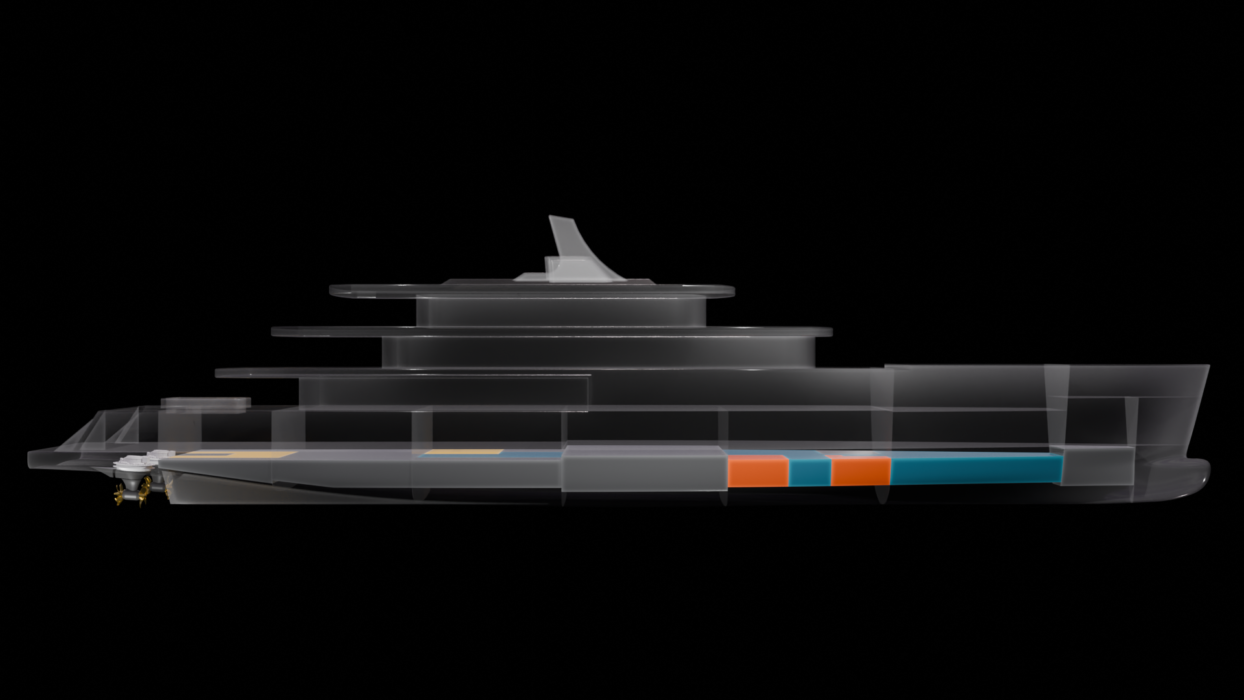
The tank deck is where energy architectures compete for space. Certain elements are fixed whatever the configuration: crew spaces forward (with 130% area vs. reference vessels), main crew stairwells linking to tender garage and lower deck, fin stabiliser foundations, technical trunks and cable routes.
Within that framework, three main architectures have been explored, with a fourth more radical methanol concept explored and then consciously set aside.
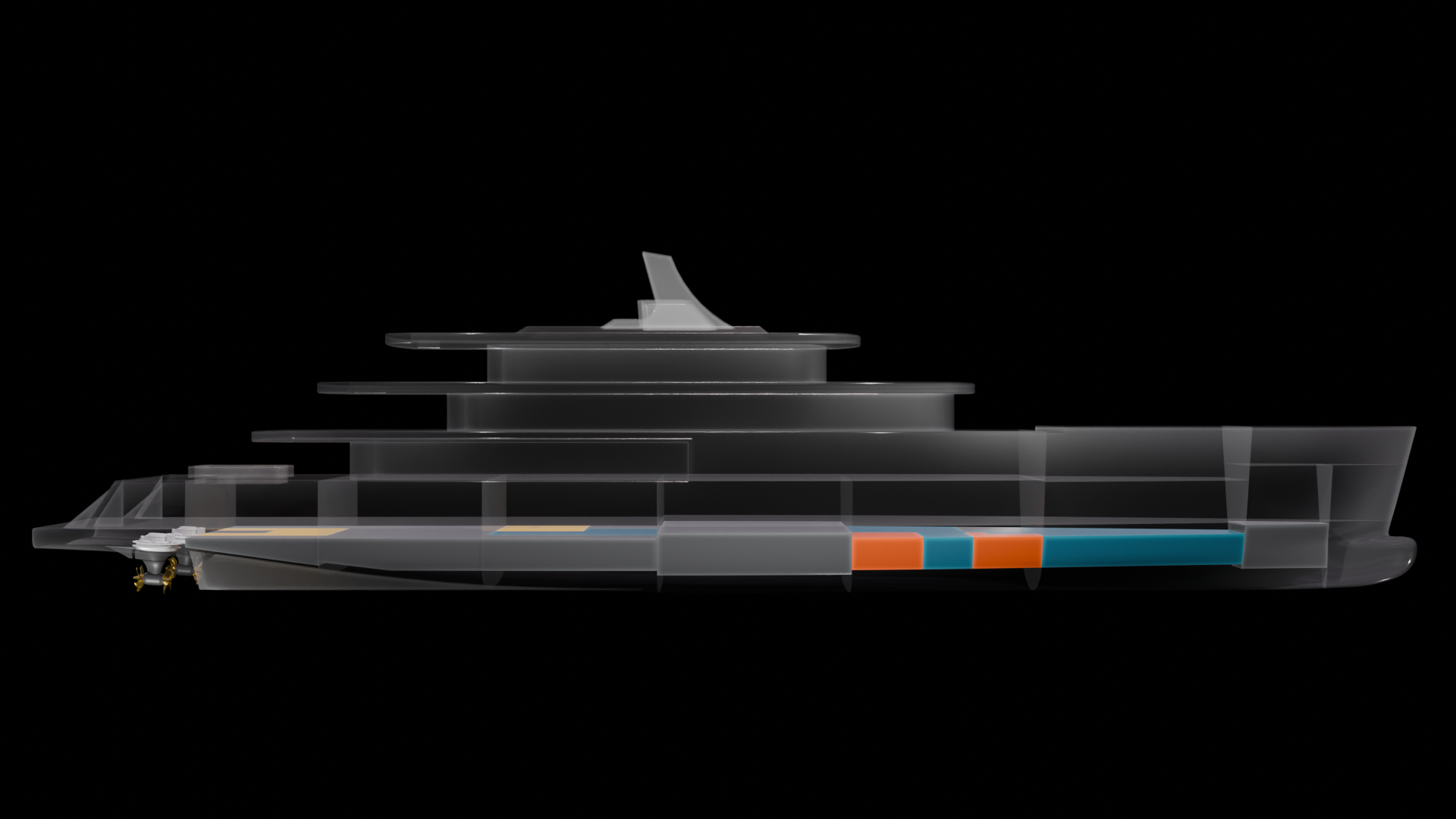
Battery-Enhanced Hybrid – Oceanco eHybrid (Baseline)
A battery bank of around 5 MWh occupies the majority of a central flexible volume. An aft flexible space of roughly 90m² remains available for additional lifestyle functions or extra tankage.
Performance:
- Top speed: 16.5 knots
- Range: 6,500 nm @ 12 knots
- Silent hotel operation: 8–10 hours continuous, up to 20 hours/24 hours with cycling
- Silent propulsion: 4–5 hours @ 8 knots (32–40 nm)
Pros:
- Significant zero-emission periods
- Optimised genset sizing and loading
- Upgrade potential as battery technology improves
Cons:
- Cost and weight of large battery installation
- Technical space penalty midships
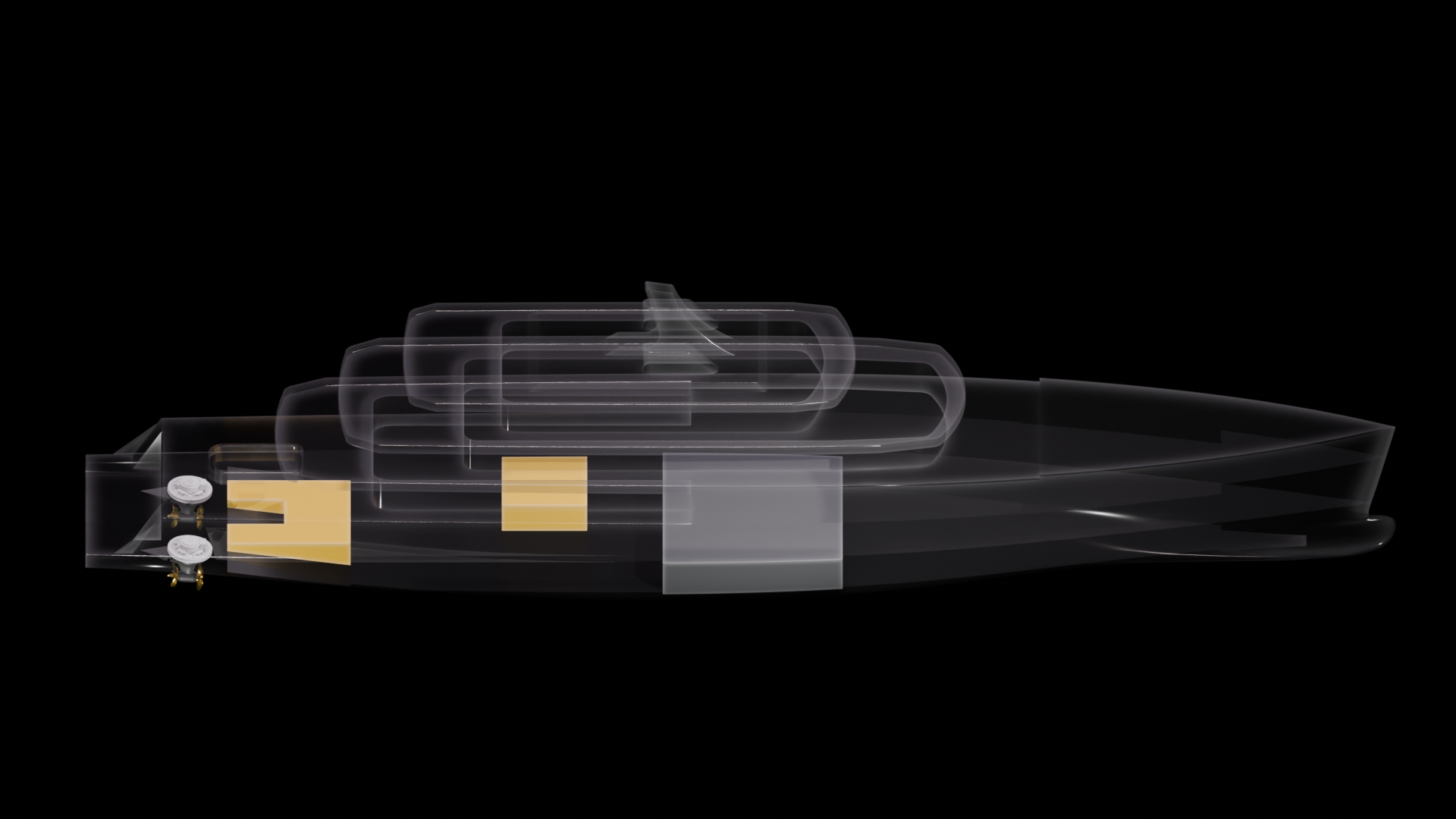
Traditional Diesel-Electric – Cost-Effective
The central battery installation shrinks to a modest peak-shaving system (~500 kWh) and the large midships flexible volume is freed. The aft flexible area grows to approximately 110m². Combined, these reclaimed spaces can house additional crew facilities, storage, wellness areas or other client-driven uses.
Performance:
- Same hydrodynamic performance: 16.5 knots / 6,500 nm @ 12 knots
Pros:
- Lowest technical risk; mature DE architecture
- Most flexible internal space; ideal for clients prioritising GA freedom or cost
- Low-carbon operation possible with HVO drop-in fuels
Cons:
- No meaningful silent propulsion
- No extended zero-emission operation; only modest noise benefit vs. baseline DE
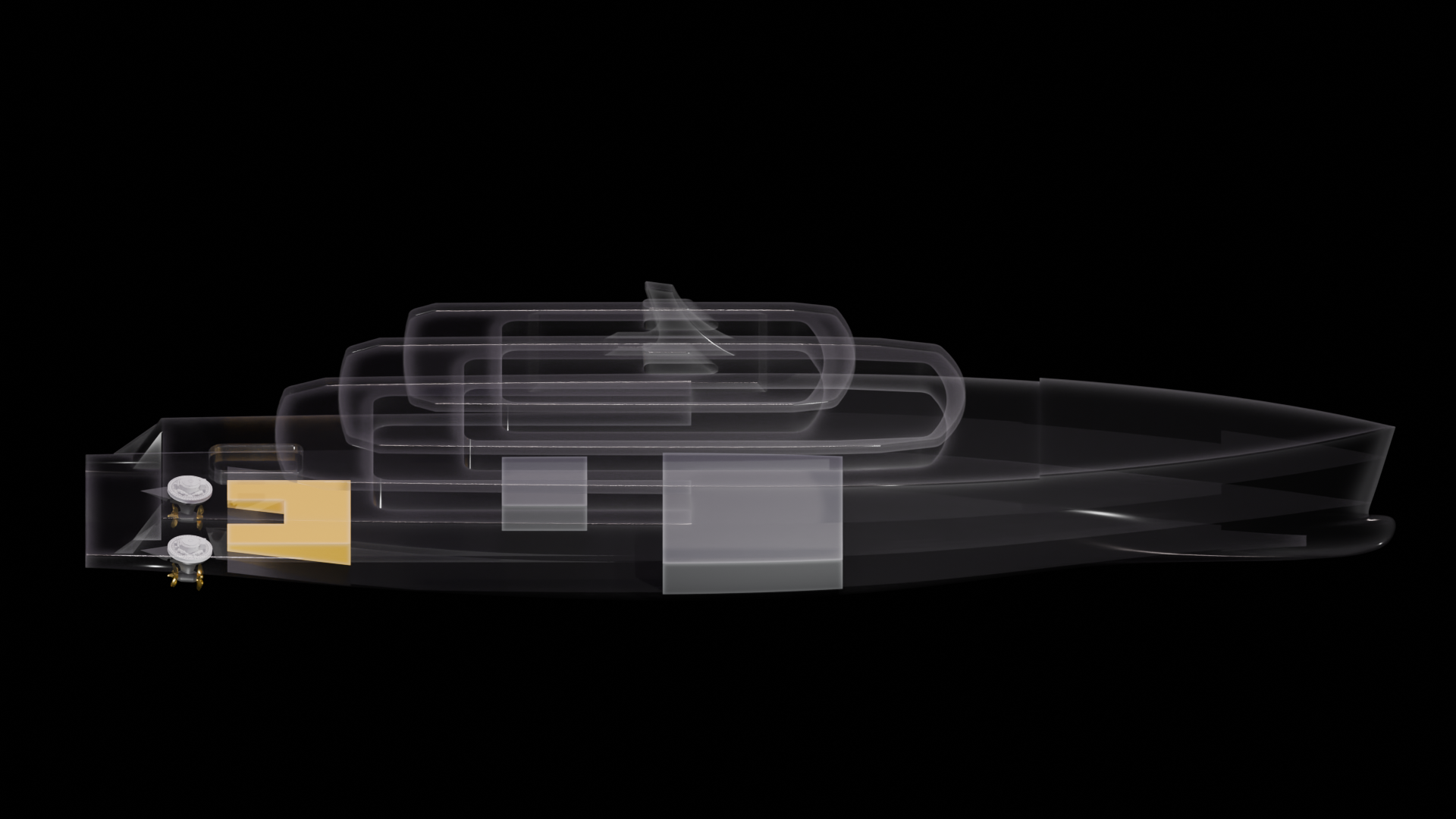
Methanol-Ready Minimum – a Dual Fuel possibility
This option will require further exploration and development to include as it would significantly reduce the overall flexible space. However, should an Owner say that this is their top priority, then it is an option DRAKE can explore.
A fuel cell room in the midships flexible space houses equipment sufficient to supply hotel loads on methanol for periods measured in weeks at anchor or slow transit. Methanol tanks and processing systems use up the aft flexible space and influence the design of outboard wing tanks. Diesel tankage is also maintained to serve the main engines driving generators.
Performance:
- Top speed: 16.5 knots
- Range: 5,000 nm @ 11 knots
- Methanol hotel load: ~3 weeks at anchor or slow transit
- No silent propulsion (propulsion remains diesel-electric)
Pros:
- High technical innovation
- Long-duration low-carbon quiet anchoring
- Clarifies path to future full methanol conversion using known architecture
Cons:
- Effective loss of both mid and aft flexible spaces (0m² remaining)
- Reduced range vs. diesel options
- Increased complexity and risk in still-maturing methanol fuel cell space
Methanol-Ready Maximum – Deliberately Discounted
A more aggressive methanol maximal concept was explored on paper. Internal combustion engines were removed entirely in favour of multiple large fuel cell rooms. Methanol tankage dominated the tank deck and wing tanks. Crew areas shrank meaningfully. Speed and range figures reduced. Technically the configuration could be made to work, but its impact on the luxury-to-technical ratio, crew conditions and platform flexibility was so great that it was judged inappropriate for a backbone intended to support multiple clients.
The conclusion was that such a concept deserves its own dedicated design process. Hydrogen falls into the same category: transformative but extremely space-hungry and technically demanding, unsuitable to retrofit into a 3,000 GT envelope without major sacrifices.
Drop-In Sustainable Fuels
All diesel-electric variants can use sustainable drop-in fuels such as hydrotreated vegetable oil (HVO) or future e-diesels to cut well-to-wake emissions without the need for new tank installation. This offers real emissions reductions where feasible today while maintaining maximum operational flexibility and avoiding the space penalties of alternative fuel storage.