DRAKE: CHAPTER FIVE
Stabilisation, Beach Club and Guest Comfort
Stabilisation Requirements and Options
For a yacht where guest comfort is a central pillar and the platform is designed for world-cruising anchorages, stabilisation performance is non-negotiable. DRAKE’s stabilisation partner, Quantum, provide three relevant products for this size range:
XT fins – traditional fins with extendable tips for enhanced zero-speed performance. Proven, cost-effective, but large chord fins can be difficult to fit within hull boundary and extend below baseline at zero speed.
Rotors (Maglift) – cylinders that rotate to generate stabilising forces. Excellent zero-speed performance without extending below baseline, but less effective above ~10–12 knots and add appendage drag.
DynaFoil – Quantum’s hybrid foil that acts like a rotor at zero speed and as a fin under way. A single pair can replace both fins and rotors. Model tests show spectacular zero-speed performance significantly above benchmark. Underway performance equivalent or better than fins.
Why DynaFoil Was Chosen
For DRAKE, the team declared early that they would not compromise on stability for cost reasons—the platform is to be benchmark-leading in seakeeping. DynaFoil offers best-in-class zero-speed behaviour in the tested size range, excellent underway performance without needing forward and aft fin pairs, and flexibility in longitudinal placement preserving GA options.
The acknowledged downside is higher cost (indicative 3.5 vs. 2.8 cost units compared with best fin+rotor combination). This was accepted as appropriate for the platform’s positioning.
Given the close link between stabilisation performance and weight management, this choice also locks in a discipline: Oceanco and Lateral’s weight engineering practices must maintain tight control over vertical centre of gravity throughout design and build. Drift in KG between concept and finished yacht can undermine performance of any stabiliser selection; DRAKE’s backbone assumes that proper weight management is part of the product.
The Triple-Aspect Beach Club
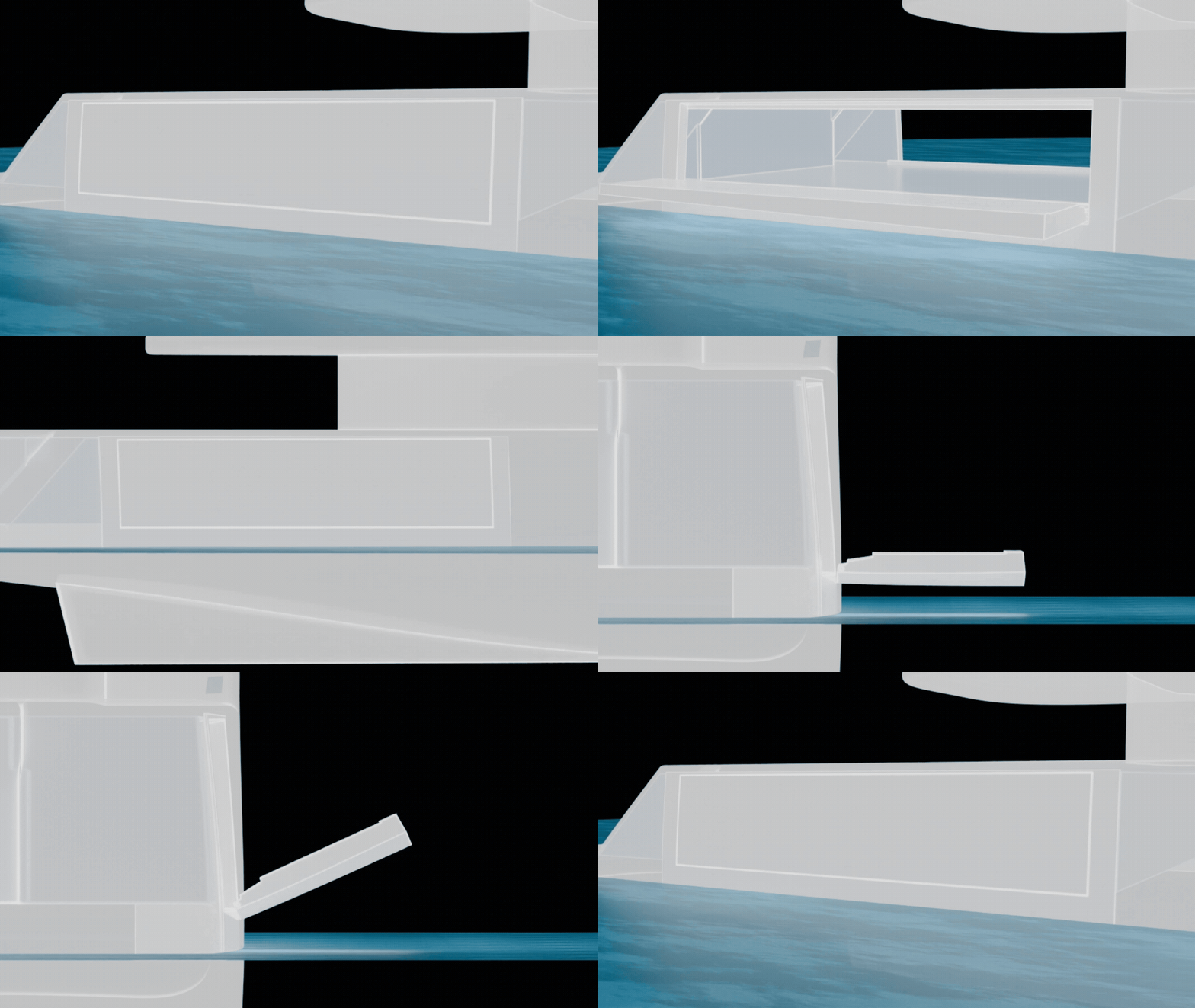
One of the most striking physical experiences of a modern large yacht is the transition from interior spaces to the water at the stern. Yet many lower deck hull side doors are constrained by slamming risk. Their undersides sit close to the waterline when fully open, so in anything other than flat conditions they must be held in partially open positions. Views are truncated, light levels drop and the sense of openness is lost.
DRAKE addresses this through both detail engineering and broader section design.
Articulated Sliding Shell Doors
Oceanco’s solution, refined on Y722, is an articulated sliding shell door. The door can open to horizontal and then translate upward, raising the platform relative to the waterline. The design targets a clearance of around 800 millimetres between the underside of open doors and the highest loaded waterline.
This is achieved via existing centreline deck heights plus either a local step in the lower deck outboard zones or a modest increase in main and lower deck heights with a small GT penalty (approximately 60 GT depending on deck step arrangements).
The consensus is that for a DRAKE-class yacht this GT cost is well worth paying to achieve a full-height triple-aspect beach club with safe, slam-free shell doors that can remain open in realistic anchorage conditions.
Beach Club Geometry and Pods
By using compact pods that fit entirely below a flush lower deck, the corners of the beach club are not compromised by machinery rooms. The full planform of the lower deck aft is available for beach club and lifestyle uses. Combined with articulated doors opening port, starboard and aft, this delivers on the promise of genuine water connection rather than a space protected behind half-open doors.
Noise and Vibration
Motion and noise are tackled through the combination of pods and DynaFoil stabilisers. With main motors housed in the pods themselves in many configurations, mechanical noise and vibration are kept outside the pressure hull. The absence of long shaft lines removes a significant source of structural-borne noise and reduces the risk of whirling modes or bearing misalignments. DynaFoil devices contribute both under way and at zero speed, delivering roll damping performance that aims to exceed benchmark yachts in the same size range without the draught and drag penalties of very large fins or rotors.
Behind the scenes, these are technical choices, but for an Owner they translate into quieter cabins, calmer salons at anchor and a crew less worn down by constant low-level motion.