DRAKE: CHAPTER THREE
The Single-Tier Engine Room Decision
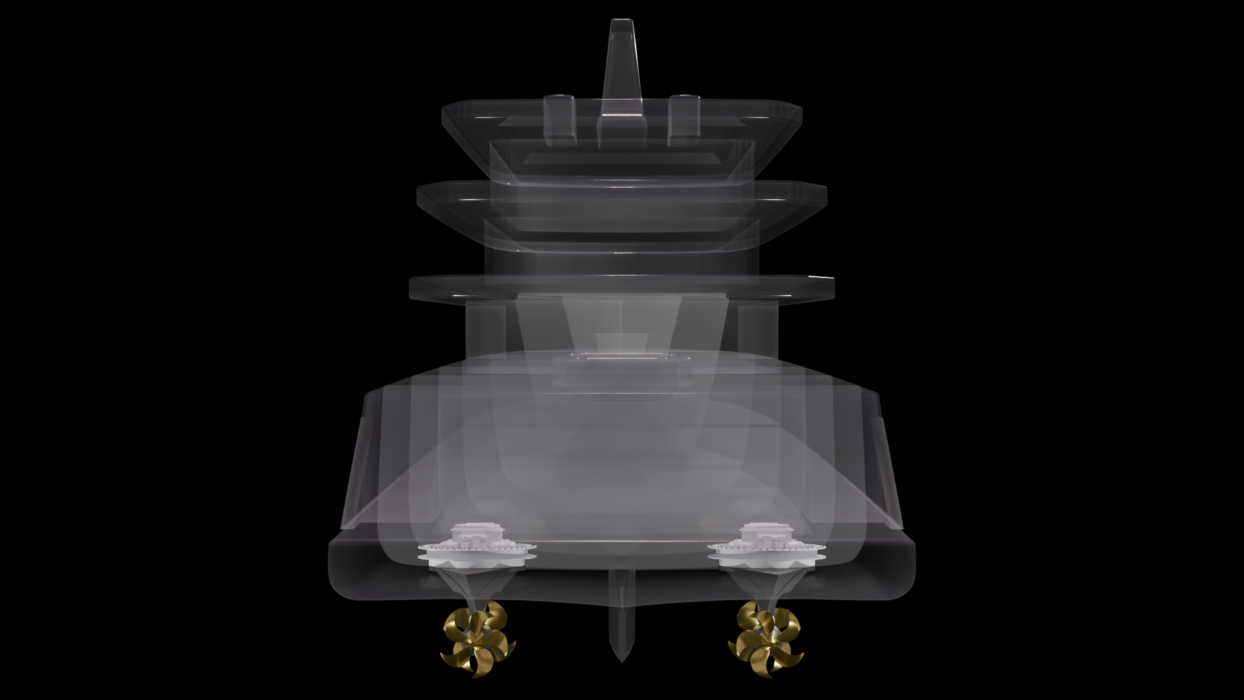
One of DRAKE’s defining structural decisions is the adoption of a single-tier engine room. In conventional yachts of around 90 metres and 3,000 GT, it is common to find a two-tier arrangement in which machinery extends over two decks. While this offers advantages in terms of accessibility and segregation of systems, it consumes a large amount of lower deck volume amidships and aft, often forcing guest spaces upwards or into less optimal sections of the hull.
DRAKE concentrates the primary machinery in a single deck-high space surrounded by a mix of crew areas, technical spaces, battery rooms, fuel cell rooms and storage.
This has three primary implications:
- Beach club and guest lower-deck volume are maximised in both area and quality of section, with no shaft tunnels cutting through
- Crew and service flows can be designed as logical loops around the STER rather than fragmented corridors
- Hull block coefficient can be tuned (0.54–0.55) to balance sufficient ER volume, seakindly transom and efficiency at sub-17 knot speeds
DEEP Propulsion Architecture
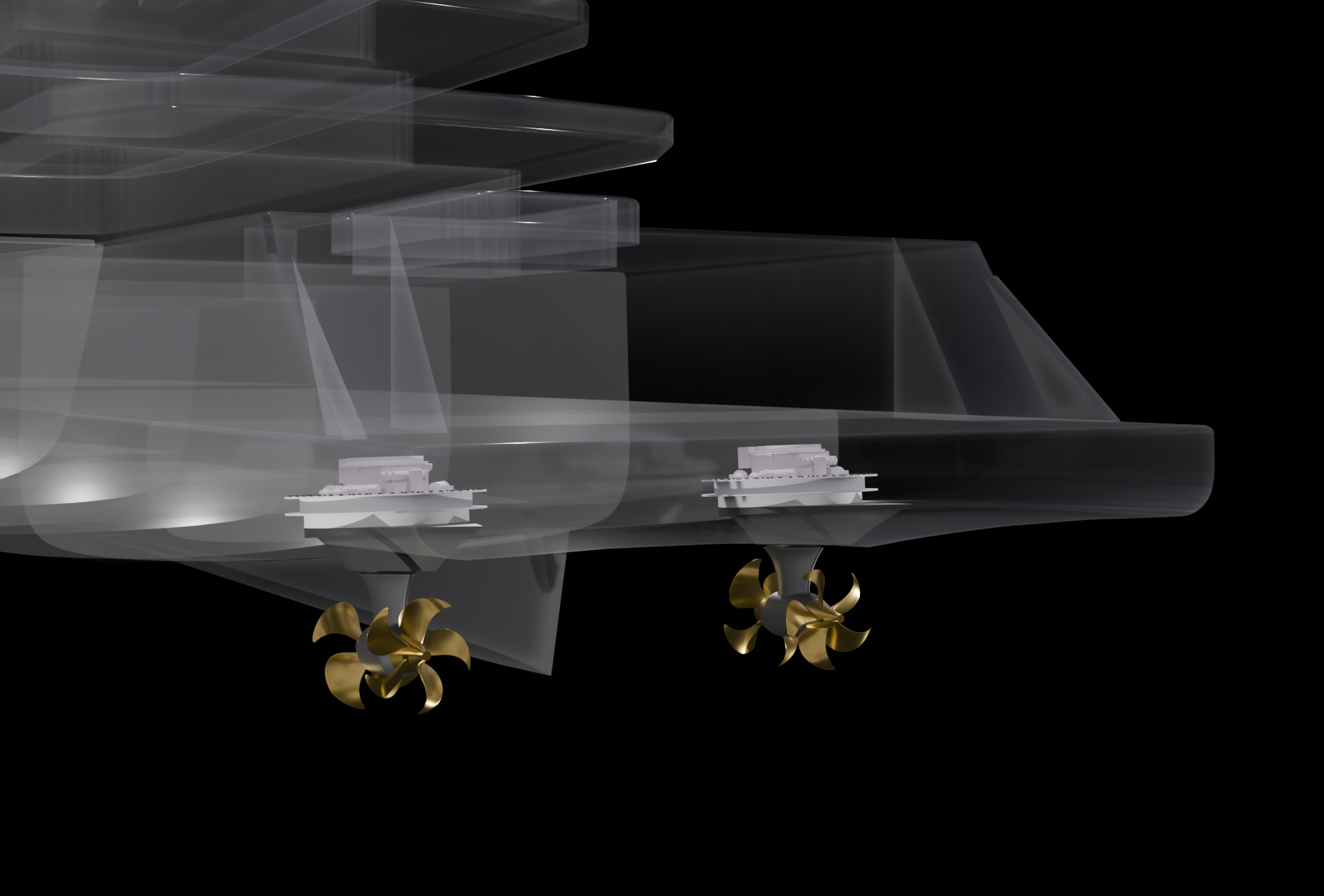
DRAKE is grounded in electric azimuthing pods rather than conventional shaft lines. The reasons combine arrangement freedom, comfort, manoeuvrability and integration with electric power systems.
Shafted yachts carry long lines of rotating machinery from engine rooms towards the stern, with gearboxes, shafts, bearings and struts occupying valuable volume and transmitting noise and vibration. Pods place the propulsors and, in many configurations, the motors themselves outside the pressure hull. Steering is achieved by rotating the entire unit rather than deflecting a rudder.
This unlocks:
- Arrangement freedom: A cleaner lower aft hull where beach clubs can be carried further aft and wider, with no pod rooms intruding into corners
- Noise and vibration: Mechanical noise generated largely outside the hull; only thrust forces transmitted through well-defined seating arrangements
- Manoeuvrability: Pods rotate through 360 degrees, offering superior vectoring performance; tests show ~38% reduction in tactical diameter vs. conventional arrangements
- System integration: Natural fit with diesel-electric or hybrid architectures as large consumers on an electric grid
The acknowledged downsides—slightly lower top speed at similar power and higher system complexity—are accepted as the price of arrangement and comfort benefits.
Pod Selection: Compact vs. High-Efficiency
Several pod families were compared:
- Compact contra-rotating pods (e.g. Veth VL1550i, 1.7 MW)
- High-efficiency pods (e.g. ABB DO860, 1.5 MW)
- Cycloidal systems (ABB Dynafin) – explicitly discounted
For DRAKE, the team selected Veth’s contra-rotating pods as baseline, with ABB-type higher-efficiency pods treated as a potential alternate option.
Veth Compact pods – pros:
- Small vertical footprint, fitting entirely below flush lower-deck beach club
- Support shallower draught and triple-aspect beach club without deep propeller tunnels
- Mature, proven references in superyacht and offshore markets
Veth Compact pods – cons:
- Slightly lower peak propulsive efficiency
- Potential need for small header boxes depending on hull shape
ABB High-efficiency pods – pros:
- Better QPC; 8–14% lower delivered power in favourable cases
- Larger propellers with lower disc loading
ABB High-efficiency pods – cons:
- Larger footprint and deeper immersion, more difficult to reconcile with triple-aspect beach club and GT constraints
- Lower top speed potential for given draught limit
Dynafin – reasons for discounting:
- Very low TRL in yachting; no installed yacht references
- Heavy units push displacement and immersion up
- High structural loads and potential low-frequency excitation risks
- DRAKE already taking innovation risk on DynaFoil stabilisers; doubling that with novel propulsion deemed inappropriate for a repeatable backbone
Hullform Strategy
The target block coefficient falls in the mid-0.5s, reflecting a compromise between volume for machinery and tankage on one hand and hydrodynamic efficiency at intended speeds on the other. Top speed is pegged in the mid-teens at about 16.5 knots depending on configuration, with cruising speed around 12 knots.
Maximum beam at waterline sits at around 14.3 metres—a moderate figure for a 3,000 GT hull that permits useful stern taper for efficiency. Full load draught is targeted at around 3.75 metres, balancing access to Caribbean and coastal anchorages with sufficient hull depth to house the single-tier engine room and a functional lower deck.
Close integration between arrangement and naval architecture is essential. DRAKE is designed from the outset as an electric drive platform, so shaft lines and their geometric constraints do not dictate the hull in the way they might on a conventional twin screw vessel.