DRAKE: CHAPTER TWO
The Technical Backbone
Not a Finished Platform
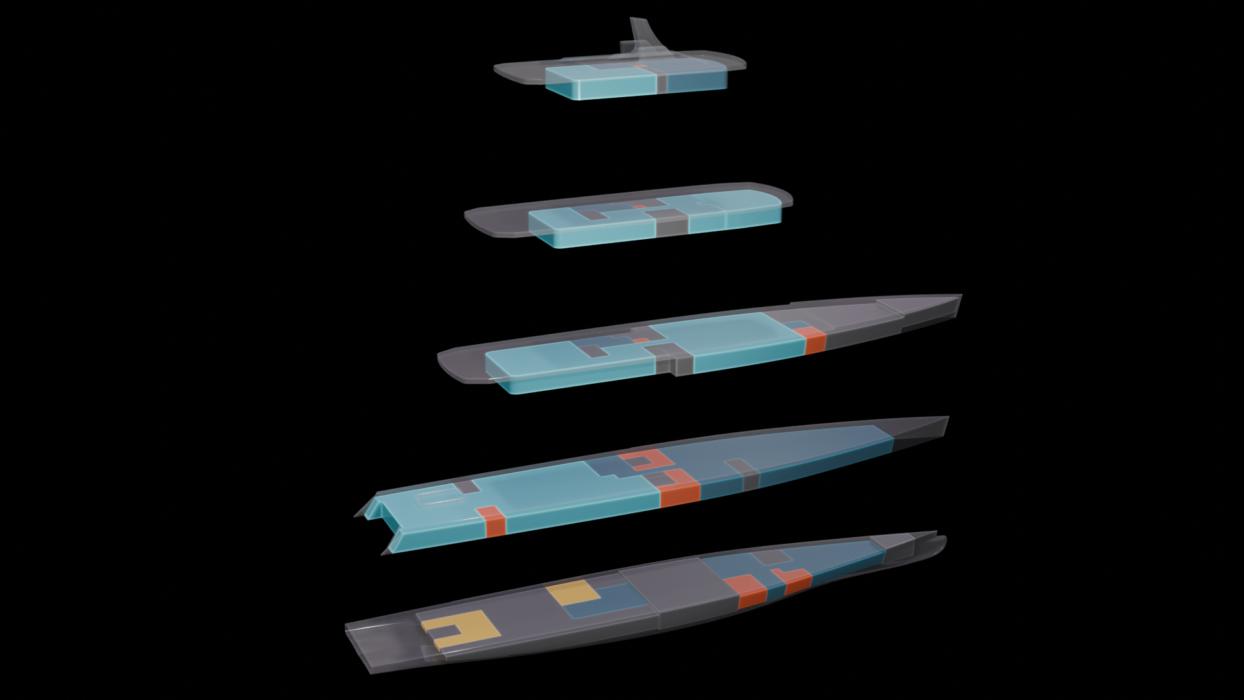
DRAKE is not a finished platform with a set general arrangement. It is a technical backbone around which each Owner’s yacht is created. The backbone defines principal dimensions, regulatory envelope, hull form targets, subdivision, watertight bulkhead strategy, position and geometry of the single-tier engine room, tank deck architecture, podded propulsion layout, stabiliser system, shell door engineering and main crew logistics routes.
It does not fix superstructure styling, interior design, detailed layout of guest accommodation, or the use of flexible spaces. This division is deliberate: approximately 50% of the yacht is “DRAKE defined” while 50% is “client defined.”
Size and Regulatory Boundaries
The backbone targets:
- LWL: Maximum 88.1m to remain below 85m Load Line regulatory boundary
- LOA: 85–96m depending on bow form and aft platform geometry
- Beam: ~14.3m at waterline – moderate with stern taper for efficiency
- Draught: ~3.75m at full load – balancing Caribbean access with hull depth for STER
- GT: Capped at 2,999 GT with explicit tools to shed up to ~400 GT if required
- Block coefficient: Mid-0.5s (0.54–0.55)
- Speed: ~16.5 knots top, ~12 knots cruise
Why Below 85m Load Line Matters
The regulatory implications are significant:
- Less onerous damage stability requirements (fewer additional watertight bulkheads)
- Avoids requirements for two rescue boats and additional davit-launched liferafts
- Allows cleaner, more intuitive circulation, especially for crew, because bulkhead count and position are not dictated by larger-ship rules
Once the hull crosses that regulatory boundary, the flow-driven general arrangement logic that underpins DRAKE becomes harder to preserve. For that reason the backbone is tied tightly to the sub-3,000 GT, sub-85m load line.
No shipyard offers an openly codified technical backbone co-developed with an operations-oriented brokerage team. DRAKE is designed to be that missing foundation.
The Market Gap
From a market standpoint, the partners identified a gap in this length space. Oceanco has platforms and builds in the 80–90m and above 90m ranges, but no offering that combines sub-3,000 GT, a single-tier engine room and a podded electric propulsion system.
Gross Tonnage Engineering
Gross tonnage is actively engineered. The design can sit just under 3,000 GT in its more generous guise and can shed approximately 400 GT through a series of measures: subtle reductions in clear heights on specific decks, treatment of beach club and some tender garages as open to sea volumes behind grilles, careful modelling of windbreaks and open decks, and placing of mooring decks behind perforated structures.
The purpose is to allow a yacht that feels subjectively larger than its official tonnage while remaining inside the regulatory and cost-bracket benefits of the 3,000 GT line.